Properties in Maricopa County face persistent colonization from Western black widows, which favor dry, undisturbed ground voids like water meter vaults, block wall expansion joints, and shaded stucco recesses near…
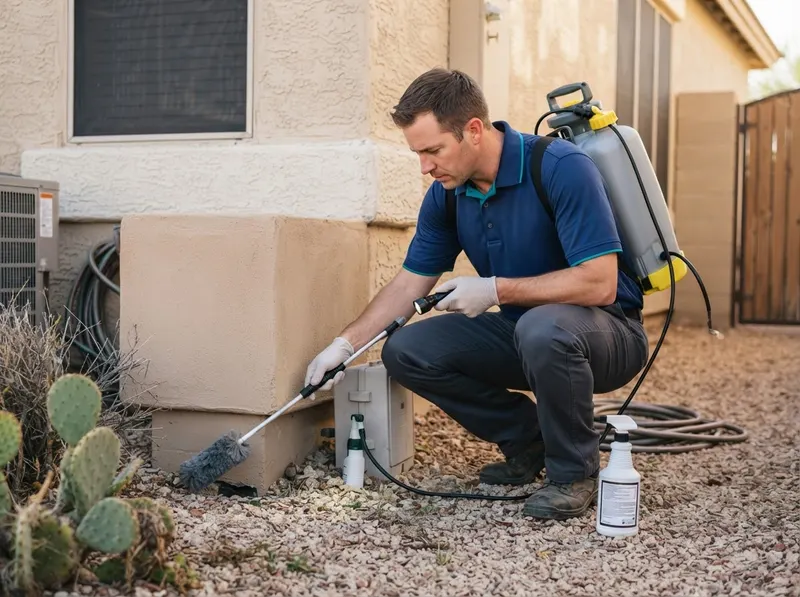
Properties in Maricopa County face persistent colonization from Western black widows, which favor dry, undisturbed ground voids like water meter vaults, block wall expansion joints, and shaded stucco recesses near irrigation heads. Standard aerosol sprays leave micro-encapsulated residues that spiders easily traverse on claw tips without absorbing a lethal dose. Effective spider management requires mechanical disruption: physically removing the tangled, irregular structural webs, stripping the papery teardrop-shaped egg sacs containing up to 900 spiderlings each, and flushing hidden recesses with micronized silica dust or microencapsulated pyrethroids that penetrate deep into block core voids.
Neighborhood architecture directly dictates the spider pressure and management protocol. In Arcadia and North Central Phoenix, mature citrus groves and flood irrigation generate continuous populations of crickets, beetles, and roaches, sustaining heavy widow colonies along wood fences and brick outbuildings. Conversely, properties bordering South Mountain Park and Preserve in Ahwatukee Foothills or flanking Camelback Mountain in the Biltmore Area experience seasonal migrations of desert funnel weavers and wolf spiders seeking interior thermal shelter as concrete foundations absorb sustained summer heat. In historic red-brick residences across the Willo Historic District and Encanto Village, unsealed subfloor vents and crawl space covers require targeted micro-injection to sever the interior harborage path.
Choosing intensive mechanical de-webbing and dust injection over a superficial liquid surface treatment trades rapid superficial coverage for thorough barrier longevity. While general perimeter sprays address transient crawling insects on flat concrete, desert spiders require direct physical elimination of their nesting matrix and structural harborages. A foundational exclusion covers exterior weep screeds, AC conduit penetration points, and block wall pilasters up to 100 linear feet, establishing a non-conducive zone that halts reproduction cycles before neonate spiderlings disperse into living quarters.
Every job gets a firm, written price after a free on-site visit.
Tell us about your black widow & desert spider management job in Phoenix and we'll send a clear, written quote, usually the same day.
 PestWatch Pest Control